
How to price a tattoo: a step-by-step formula for artists
Learn how working backward from your desired monthly income can help you establish an accurate hourly rate that covers touch-ups, studio commissions, and material costs

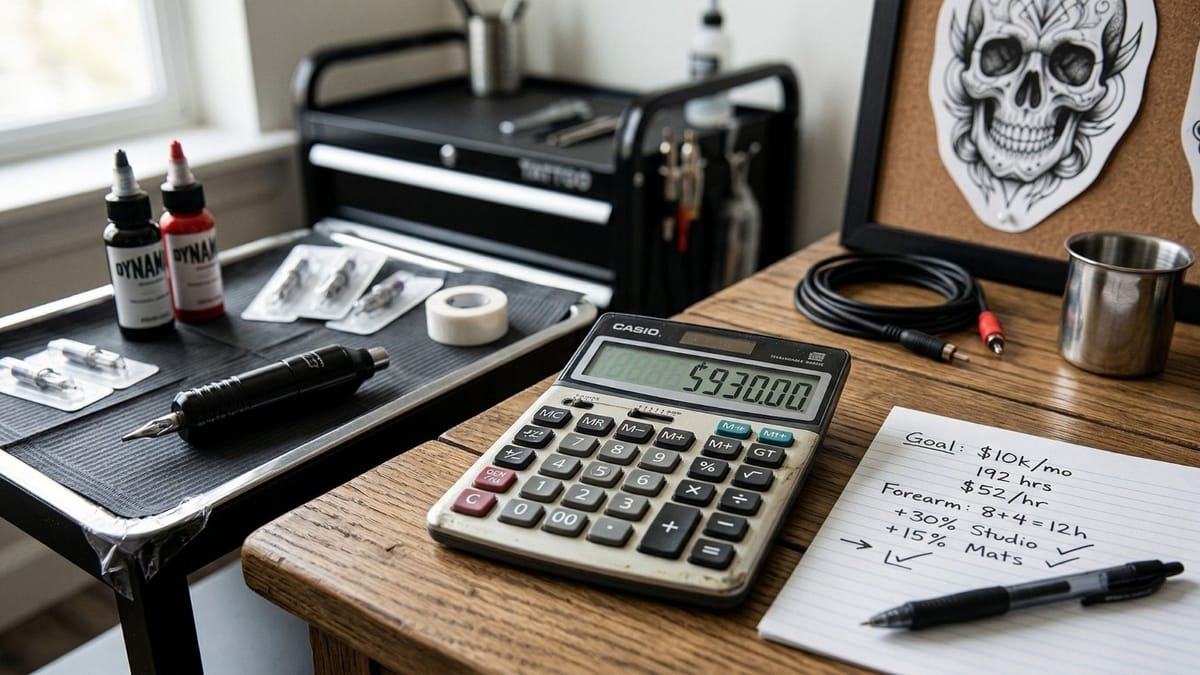
Many tattoo artists struggle with determining how much to charge for a tattoo. That’s fair, pricing your own art is not an easy task. To achieve this, you simply need to answer one fundamental question.
Determine how much you want to make per month. This baseline number will guide the entire calculation. Be honest with yourself and consider your specific niche, your location, and the session rates of well-positioned competitors. Establish a target revenue that reflects your professional goals while remaining realistic within your market.
To illustrate this pricing model, assume a flat monthly target of $10,000. If this is not your current goal, you can adjust the numbers based on what you consider appropriate. The $10,000 figure serves merely as a starting point to demonstrate a simple and effective method for pricing your work. 😉
Ok: if your goal is $10,000 per month and your schedule consists of eight-hour workdays totaling roughly 48 hours a week, you are looking at approximately 192 working hours per month. To reach that $10,000 mark, your hourly rate must be set at approximately $52.
Suppose you receive a request for a detailed forearm tattoo that requires an estimated full-day session of eight hours to execute at your highest quality standard.
“So, 8 hours multiplied by $52 is $416. Is that the price I should charge?" — Well, if you want to kill your career and work for free, maybe. Keep going to understand the whole process, because the formula is just the beginning.
It is necessary to account for potential touch-ups. A safe approach is to add an estimated 3-4 extra hours to your quote. This adjustment brings your predictable labor to 12 hours. At a rate of $52 per hour, the base cost reaches $624.
Next, you must factor in studio fees. If your studio takes a 30% commission per piece, that percentage must be incorporated into the price to protect your monthly income goal. Adding this 30% margin brings the subtotal to $811.20.
Material costs are another crucial factor. Even if you work in a studio that provides basic supplies like needles, ink, general products, gloves, and masks, you should still consider the natural wear and tear of your machine. Adding an additional 15% to cover these ongoing expenses simplifies the process and brings the running total to roughly $932.
Pricing strategy also plays a role at this stage. If there is an expectation that the client will negotiate, you might initially quote the piece between $1,000-1,200. This allows room to offer a discount and close the sale near your $930 target, preventing financial loss from price negotiations, which are common in the industry.
Breaking down the math, the initial eight-hour tattoo session totals $416. Adding four predictable hours for touch-ups raises the base to $624. Incorporating a 30% studio commission brings the figure to $811.20. Finally, factoring in an additional 15% for material expenses results in $932.88, making your final rounded price roughly $930.
So, at the end of the day, the formula is:
➔ Estimate your monthly income goal
➔ Divide it by the amount of hours worked in a month
➔ You will have your base hourly rate
➔ Received a quote request? Estimate how many hours you will spend doing it
➔ Add 4 hours for future touch-ups as a safety margin
➔ Multiply the total hours by your hourly rate
➔ Add the studio commission percentage
➔ Add 15% for materials over the total amount
➔ Always quote slightly higher to allow room for negotiation
➔ You will have exactly how much you should charge for your tattoo
Of course, this is not a rule: it’s just a starting point...

This formula serves as a foundational starting point rather than an absolute rule. It ensures you charge fairly, cover overhead costs, manage commissions, and remain aligned with your financial objectives. The calculation scales in complexity once you factor in taxes, advertising budgets, team salaries, software subscriptions, and other business expenses.
It is also important to remember that while you may estimate an eight-hour session, the actual time could be shorter, or you might not require the allocated touch-up hours. Conversely, the full 12-hour projection might be necessary depending on the client's skin type and healing process. All scenarios are possible, which is why accounting for every potential cost is essential. We invite you to share your thoughts or alternative pricing methods in the comment section below.